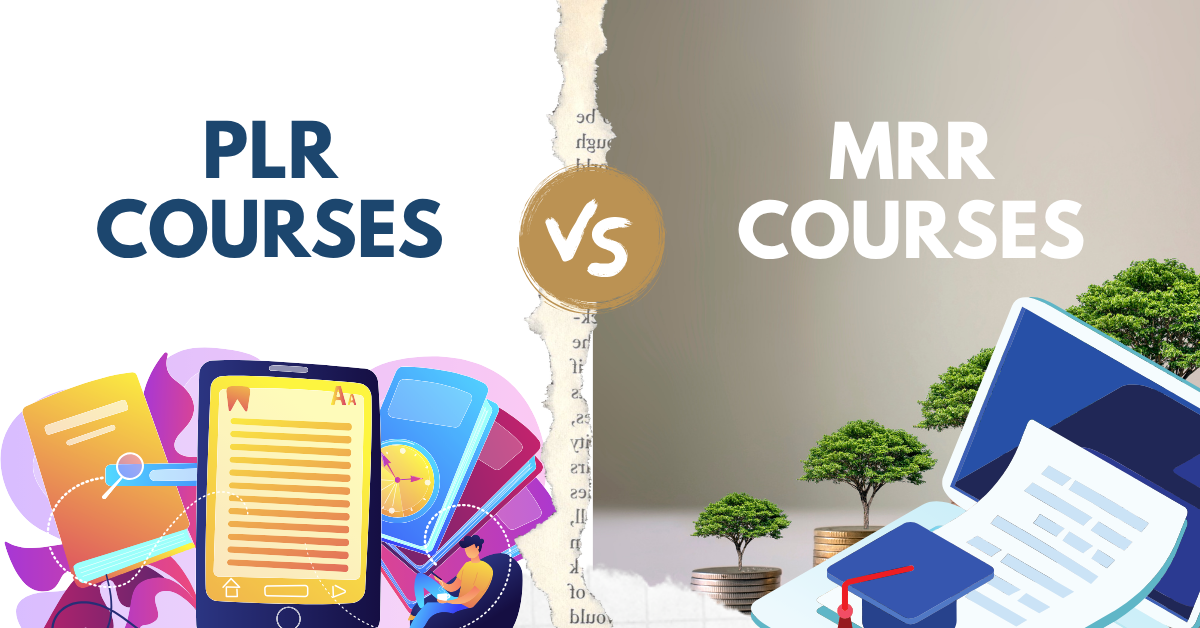
PLR courses and MRR courses.
And honestly — most people confuse them.
At first glance, they look almost identical. Both allow you to sell ready-made courses without creating everything from scratch. Both are widely used by creators, coaches, and digital product sellers who want to launch faster instead of spending months building content.
But the real difference isn’t about the courses themselves.
👉 It’s about what you’re allowed to do with them.
Some courses let you edit everything — change branding, rewrite lessons, and turn the content into your own. Others are designed to be resold mostly as-is, with limited customization.
That’s where the distinction between PLR and MRR becomes important.
Understanding this difference can save you a lot of time — and prevent costly mistakes when choosing courses you plan to sell.
And if you’re still exploring where to actually get reliable training materials, you can check this curated list of platforms offering ready-made courses you can resell.
In this guide, we’ll break everything down in simple terms — what PLR courses are, what MRR courses are, how they differ, and which option makes more sense depending on your goals.
What Are PLR Courses?

PLR courses — short for private label rights courses — are pre-created training programs that you can modify, brand, and sell as your own.
Instead of building a course from scratch, you start with a structured set of materials that are already organized into modules and lessons. These typically include teaching content along with supporting assets like worksheets, slides, and action guides.
That’s what makes PLR courses especially attractive for people who want to launch faster without sacrificing flexibility.
In most cases, private label rights courses allow you to:
- Edit the course content
- Rebrand it with your logo and name
- Rewrite or expand lessons
- Sell the course as your own product
- Bundle it with other materials
- Use it inside memberships or coaching programs
That level of control is what makes PLR different from most other types of resell content.
Instead of just reselling a finished product, you’re essentially working with a customizable foundation — something you can shape to match your niche, audience, or teaching style.
This flexibility is also why many creators prefer PLR when building long-term products. You’re not limited to one format — the same course content can be repurposed into videos, workshops, or even lead magnets.
If you’re curious how this works in practice, many sellers build complete offers using structured materials from ready-made course libraries designed for customization.
And in most real-world use cases, that flexibility makes PLR courses one of the most practical starting points for launching digital products quickly.
What Are MRR Courses?
MRR courses — short for master resell rights courses — are ready-made training products that you can resell to others without creating the content yourself.
At a basic level, they work similarly to PLR courses. You purchase the course once, and then you’re allowed to sell it to customers and keep the profits.
But the main difference is how much you’re allowed to modify the content.
Most master resell rights courses allow you to:
- Sell the course as-is
- Keep 100% of the profits
- Deliver it under your own brand or storefront
- Bundle it with other products
- Sometimes pass resale rights to your buyers
That last point is what makes MRR unique.
In some cases, your customers can also receive resale rights, meaning they can sell the same product again. This creates a chain-style resale model that’s common in certain digital product markets.
However, editing permissions are usually limited.
Unlike PLR content, many MRR courses are designed to be sold in their original form. You might be able to add simple branding, but rewriting lessons, restructuring modules, or deeply modifying the content is often restricted.
Because of that, MRR courses are commonly associated with finished video programs or packaged digital products that are ready to sell immediately.
And for people who want to launch quickly without spending time editing, that speed can be a major advantage.
PLR vs MRR Courses: Key Differences
At first glance, PLR and MRR courses may seem interchangeable. Both allow you to sell ready-made training products without building everything from scratch.
But once you look closer, the differences become clear — especially when it comes to editing rights and long-term flexibility.
Here’s a side-by-side breakdown that makes the distinction easier to understand.
| Feature | PLR Courses | MRR Courses |
|---|---|---|
| Can edit content | ✅ Yes — full editing is usually allowed | ❌ Limited — often sold as-is |
| Can rebrand | ✅ Yes — change names, branding, and structure | ⚠️ Sometimes — usually minor branding only |
| Can resell | ✅ Yes | ✅ Yes |
| Can pass resale rights | ❌ Usually not allowed | ⚠️ Sometimes allowed |
| Best for | Customizing content and building branded products | Selling ready-made products quickly |
| Biggest limitation | Requires editing to stand out | Limited customization options |
This is the section most people care about when comparing PLR vs MRR courses — because the decision usually comes down to flexibility versus speed.
PLR gives you more control.
MRR gives you faster resale.
But neither is universally better — the right choice depends on what you’re trying to build.
For example, many creators who want to develop branded programs or coaching offers lean toward editable course frameworks that allow deeper customization.
And that’s usually where PLR becomes more valuable.

Which Is Better: PLR or MRR Courses?
For most people, PLR courses are usually the better long-term option.
Not because MRR is bad — but because flexibility matters more than speed in most real-world situations.
With PLR, you’re not just reselling content.
You’re building something that can evolve over time.
You can:
- Adjust the content to match your audience
- Expand lessons with your own ideas
- Add branding and personality
- Combine materials into larger programs
- Create unique offers instead of selling identical products
That makes it easier to stand out — especially in competitive niches.
MRR courses, on the other hand, are better suited for situations where speed matters more than customization.
If your goal is to launch quickly and sell a ready-made product without spending time editing or restructuring content, MRR can be a practical shortcut.
This is especially true with finished video programs, where recording lessons from scratch would take weeks or months.
That’s why some beginners start with ready-to-sell video courses that require minimal editing before launch.
But in the long run, most creators find that customization creates more value — and that’s exactly where PLR tends to win.
Not because it’s easier…
But because it gives you more control over what you’re building.
When PLR Courses Make More Sense
PLR courses make the most sense when you’re trying to build something that actually belongs to your brand — not just resell someone else’s product.
If your goal is long-term growth, customization becomes extremely important.
That’s where private label rights courses usually outperform other licensing models.
PLR works especially well when you’re:
- Building a personal or business brand
If your name or brand matters, you’ll want content that can be customized to match your voice and positioning. - Creating coaching programs
Coaches often modify lessons, add examples, and tailor content to specific clients. PLR gives you the freedom to do that. - Running membership sites
Membership content needs to feel fresh and structured. PLR allows you to expand, repurpose, and organize materials into ongoing programs. - Targeting niche audiences
Generic courses rarely perform well in narrow niches. PLR lets you adapt content to specific industries, audiences, or problems. - Improving perceived value
When you customize a course — change design, rewrite sections, add bonuses — the product feels more original and valuable.
In most real-world situations, PLR is less about speed and more about control.
And when you’re building something meant to last — control matters more than convenience.
When MRR Courses Make More Sense
MRR courses make more sense when speed matters more than customization.
If your goal is to launch quickly and start selling without spending hours editing content, master resell rights courses can be a practical option.
They’re especially useful when you:
- Want a ready-made product fast
MRR courses are usually designed to be sold immediately, with minimal setup. - Don’t want to spend time editing content
If customization isn’t your priority, selling the product as-is saves time. - Are okay with limited differentiation
Since many buyers may sell the same course, standing out depends more on marketing than content changes. - Need a fast starting point
Some beginners use MRR products to test markets before investing in custom content.
The trade-off is simple:
👉 Speed over uniqueness
For some users, that’s perfectly fine — especially when launching quickly matters more than building something fully customized.

Can a Course Be Both PLR and MRR?
Yes — but this is where many people get confused.
Some courses are sold with multiple licensing options, meaning the same course could technically be available as both PLR and MRR, depending on the package you purchase.
However, the real confusion usually comes from labels.
Many platforms use terms like:
PLR
MRR
Resell Rights
White Label
Almost interchangeably — even when the permissions are completely different.
Some platforms also use white label licensing, which sits somewhere between PLR and MRR. If you’re curious how that works, this guide explains how white label courses to resell actually function.
That’s why you should never rely on the category name alone.
Instead, always check the actual license terms attached to the product.
Look for clear details about:
- Whether editing is allowed
- Whether rebranding is allowed
- Whether resale rights can be passed to buyers
- Any platform or usage restrictions
The safest rule is simple:
👉 Always verify the license at the product level — not just the category level.
That one habit prevents more mistakes than almost anything else when working with resellable courses.
Best Choice for Most Beginners
For most beginners, PLR courses are usually the better starting point.
Not because MRR courses don’t work — but because flexibility matters more when you’re still figuring things out.
With PLR, you can modify the content, adjust the structure, and reshape the course to match your niche. That gives you room to experiment without being locked into a fixed product.
If your audience changes or your niche becomes more specific, you can update the content instead of starting over.
That kind of flexibility makes a big difference early on.
MRR courses can still be useful, especially if you want something ready to sell immediately. But in most beginner situations, the ability to customize — even slightly — usually leads to better long-term results.
So if you’re unsure where to start, PLR is typically the safer and more adaptable option.
Where to Find PLR and MRR Courses

Once you understand the difference between PLR and MRR, the next step is finding platforms that actually offer usable courses — not just random files labeled as training programs.
Some websites specialize in structured course kits, while others focus on video-based training or modular content that can be turned into full programs.
Here are a few well-known platforms worth exploring:
Tools For Motivation — Focuses mainly on self-help and personal development courses. Many of their packages include structured modules, worksheets, videos, and marketing materials, making them suitable for coaches and workshop creators.
PLR.me — Offers a mix of mini-courses, coaching programs, and supporting materials. While the number of full courses is smaller, the platform is useful for building custom programs using structured lesson resources.
Content Sparks — Known for business-focused white-label course kits. Many of their courses include teaching materials along with sales funnels, email sequences, and promotional assets.
These are just a few examples, but there are several other platforms worth comparing depending on your niche and goals.
If you want a deeper breakdown of available options, you can explore this full comparison of PLR & MRR courses to resell: 7 best sites compared.
That guide walks through the strongest platforms in more detail, including licensing differences and what you can realistically expect inside each course package.
Amazing article, exactly what I was looking for as a coach!:)
Wohh just what I was looking for, thanks for putting up. Great way to put get online course out quickly!